Dog Walking Rules in Berwick Parks
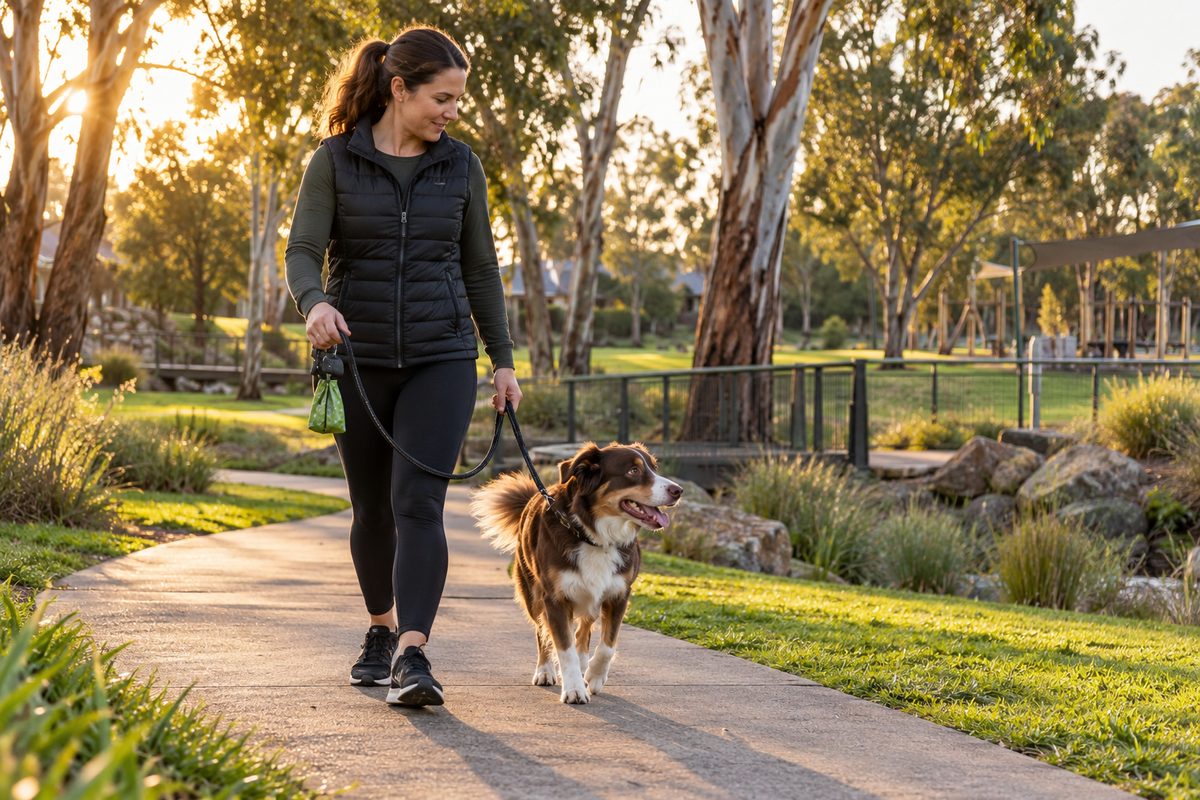
In Berwick parks, your dog must stay on a leash unless a council sign marks the area as off-leash, and you must clean up after it every time. One big park is the exception to everything: Wilson Botanic Park does not allow dogs at all, apart from assistance dogs. The rest of this guide explains where those rules come from, where they get stricter, and the small mistakes that catch out even careful owners.
The big idea is simple. In Berwick, the sign at the park entrance tells you more than any general rule can. Your job as a dog walker is to read it, then match your dog's behaviour to it.
Who sets the rules for dogs in Berwick parks?
The City of Casey sets them. Berwick, Victoria sits inside the City of Casey, so the council's local laws and its dog orders apply in every council park, reserve and street in the suburb.
Those orders sit on top of a state law, the Victorian Domestic Animals Act 1994. The Act lets each council decide where dogs must be leashed, where they can run free and where they are banned. That is why rules can change when you cross a council boundary. A park in a neighbouring council area may follow different rules from one in Berwick.
Here is what that means in practice:
- The state law sets the base rules, such as registration, microchipping and control of your dog.
- The City of Casey decides the local details, such as which reserves are off-leash and where dogs are prohibited.
- Park signs show you how those local details apply at that exact spot.
Council rules can be updated. Before you rely on any off-leash area, check the current list on the City of Casey website or call the council. Signs on site always win over old information.
When does your dog need to be on a leash?
Almost always. Across the City of Casey, dogs must be on a leash in public places unless they are inside a signed off-leash area. That covers footpaths, shared trails, most park lawns and the paths around sports grounds.
A leash rule means more than clipping a lead to the collar. The lead should be held by a person who can control the dog. A long, loose lead that lets your dog reach other walkers, children or birds does not really keep it under control.
Some dogs must be leashed at all times, even in off-leash areas. Under Victorian law, dogs declared dangerous, menacing or restricted breed have tighter rules, including leash and muzzle requirements in public. If your dog has one of these declarations, off-leash areas are not open to it.
A hypothetical example
Picture an owner walking a calm older Labrador along a quiet path on a weekday morning. Nobody is around, so they let it off the lead. It feels harmless. But the path is not signed as off-leash, so the dog is breaking the rule. A council officer could issue a fine, and if a cyclist comes around the bend and the dog steps out, the owner is responsible for what happens next. Quiet paths are still leash paths.
What does "off-leash" actually allow?
Off-leash means your dog can be free of the lead. It does not mean your dog can do what it likes. In Victoria, a dog in an off-leash area must still be under effective control.
In plain terms, that means:
- Your dog stays in your sight the whole time.
- Your dog comes back when you call it, the first time.
- You carry a leash so you can clip it on quickly.
- You stop your dog from rushing at people, other dogs or animals.
This is the part most guides skip. Many owners treat recall as optional because the area is off-leash. The law treats recall as the condition that makes off-leash allowed. If your dog ignores you when it spots another dog across the oval, it is not under effective control, even in an off-leash zone.
Off-leash areas in the City of Casey can also have time limits or shared use. Some sports reserves allow off-leash dogs only when no organised sport or training is on. If a game starts, the dog goes back on the lead. Read the sign for hours and conditions before you unclip.
Why can't you take your dog into Wilson Botanic Park?
Because the park protects plants and animals that dogs would disturb. Wilson Botanic Park is a dog-free park. Only assistance dogs are allowed in.
The park sits on an old quarry site and now holds lakes, garden beds and bushland. That mix creates habitat for birds, frogs and small animals. A dog does not have to chase anything to cause harm. Its smell alone can make wildlife leave nesting spots, and that effect lasts after the dog has gone.
Owners sometimes ask whether a dog in a bag or held in arms counts. It does not. The rule covers the dog, however it travels. If you plan a day at the park, leave the dog at home or plan your dog walk somewhere else in Berwick first. Our Berwick Village Notes guides cover the park itself in more detail.
Where do dogs need extra care around picnic spots and barbecues?
Near play spaces and food areas. Many Victorian councils, including the City of Casey, restrict dogs close to children's playgrounds and picnic or barbecue areas. Some of those restrictions are a set distance from the equipment. Others apply only when the area is in use. Check the sign at each park, as the exact rule can differ.
Even where a dog is allowed to pass by, a barbecue area brings its own problems:
- A hot barbecue grill can burn a dog that jumps up or sniffs too close.
- Dropped food, bones and skewers can make dogs sick or cause choking.
- Families eating at a barbecue may not want a dog at their table, even a friendly one.
The safest habit is to keep a short lead and walk wide around any public barbecue. If you want to have a barbecue with your dog along, pick a table at the edge of the picnic area, tie off the lead to something solid, and keep the dog well back from the cooking plate.
A hypothetical example
Imagine a family cooking sausages on a Saturday. A dog on a long retractable lead reaches the barbecue grill before its owner notices. Nobody gets hurt, but the sausages hit the ground and the family is upset. A short fixed lead would have stopped it. This is the kind of moment that leads to complaints, and complaints lead councils to tighten rules for everyone.
How do the rules play out at Edwin Flack Park and Berwick Springs?
Both are council parks, so City of Casey rules apply: dogs on a leash unless a sign says otherwise, and owners clean up. The setting of each park changes how you should walk there.
Edwin Flack Park
Edwin Flack Park is named after Edwin Flack, Australia's first Olympian, who won gold at the 1896 Athens Games and is buried in Berwick. The park is a busy local space with sporting grounds, play areas and barbecue facilities. That mix of children, sport and food is exactly where leash rules matter most.
When you walk here:
- Keep your dog leashed on paths and near the play spaces.
- Stay clear of the barbecue areas, especially on weekends.
- Do not let your dog onto a sports field while a game or training session is running.
- Look for signs before assuming any open grass is off-leash.
Berwick Springs
Berwick Springs has lakes and wetland areas that attract waterbirds and other wildlife. Wetland edges are habitat, and ground-nesting or water birds are easy for a dog to disturb.
When you walk here:
- Keep your dog on the path and out of the water's edge plants.
- Do not let your dog chase ducks or swim after birds.
- Use a short lead in spring, when many birds nest and raise young.
A loose dog at a wetland can scatter a whole group of birds in seconds. Chicks that get separated from parents often do not survive. That is why leash rules near water make sense even when the area looks empty.
What paperwork does your dog need before you walk it?
Registration and a microchip. In Victoria, dogs must be microchipped and registered with their local council from three months of age. For Berwick, that council is the City of Casey.
Registration renews each year. In Victoria, it is due by 10 April. Your dog should wear its council registration tag when it is out in public. The tag helps council officers or the public get a lost dog home quickly.
Keep your contact details on the microchip register up to date. A microchip with an old phone number is close to useless if your dog runs off in a park.
What do you need to carry on every walk?
A leash and a way to pick up after your dog. The City of Casey requires owners to remove their dog's droppings from public places and dispose of them properly. Carrying bags means you are ready, even if the park dispenser is empty.
A good walk kit is small:
- A fixed-length lead, even for off-leash areas.
- Several poo bags, more than you think you need.
- Water for your dog on warm days, as many paths have no taps.
Bag it and bin it. Leaving a tied bag beside the path is still littering. If the bin is full, take the bag home.
What do dog walkers most often get wrong?
They assume. Most problems come from owners guessing the rules instead of checking them. Here are the common mistakes:
- Treating open grass as off-leash. A big empty lawn is still a leash area unless signed.
- Using a retractable lead as a "leash". At full length, it gives you little control near paths, children and barbecues.
- Ignoring recall in off-leash areas. If your dog will not come back, it should not be off the lead.
- Forgetting Wilson Botanic Park is dog-free. Visitors from other suburbs often arrive with dogs and get turned away.
- Letting dogs into wetlands. At places like Berwick Springs, this disturbs wildlife and damages habitat.
- Relying on old information. Council off-leash areas and hours can change. The sign at the gate is the current rule.
Each of these can lead to a council fine. More often, they lead to a tense moment with another park user. Following the rules keeps your walk calm and keeps parks open to dogs in the long run.
Your next step
Read the sign at the park entrance before you unclip the lead. That single habit covers most of the dog walking rules in Berwick parks, because the sign shows how the City of Casey rules apply to that exact spot.
To get set up properly:
- Check your dog's registration with the City of Casey is current, and that its tag is on its collar.
- Update your contact details on the microchip register.
- Look up the current list of off-leash areas on the City of Casey website.
- Pack a fixed lead and spare poo bags before every walk.
- Practise recall in a quiet fenced space before trying any off-leash area.
- Leave your dog at home when you visit Wilson Botanic Park.
For more on parks, walks and local life in the suburb, browse the guides at Berwick Village Notes.