Birdwatching at Wilson Botanic Park Berwick
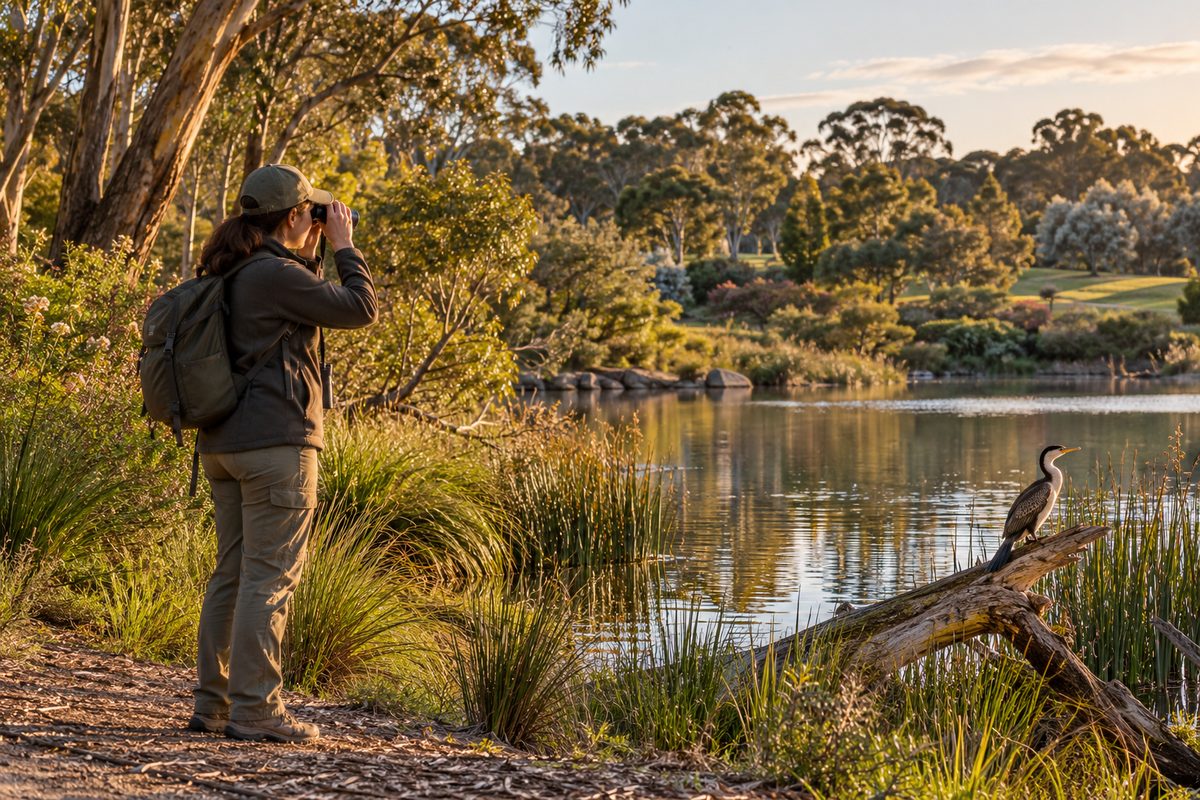
Wilson Botanic Park is one of the easiest places in Berwick to see a good mix of birds, because its quarry lake brings in water birds and its flowering native gardens feed honeyeaters, all along one short loop. You do not need much gear or skill to start. You need the right timing, a slow pace and a rough idea of which bird lives where. This guide sets that out so your first visit gives you more than a list of brown blurs.
The park sits on the Princes Highway in Berwick, Victoria, and the City of Casey manages it. Entry is free. If you want the general visitor basics, such as parking and facilities, start with the local guides on Berwick Village Notes. This article sticks to birds.
Why does an old quarry make such good bird habitat?
The park was built on a former quarry. That history is the main reason birdwatching works so well here. When quarrying stopped, the deep pit filled with water and became the quarry lake that sits at the heart of the park today. Steep rock faces, open water, reedy edges and planted gardens now sit close together.
Birds care about edges. A place where water meets reeds, or where lawn meets a dense shrub bed, offers food and cover in one spot. Most suburban parks have one or two of these edges. Wilson Botanic Park packs many of them into a small area, so you can walk a few minutes and move from one bird community to another.
The botanical garden plantings matter just as much. Many beds hold Australian native shrubs such as grevilleas, banksias and correas. These plants produce nectar across different months. Nectar-feeding birds follow that supply, which means the gardens stay busy for much of the year, including winter.
So think of the park as two zones. The lake zone is for water birds. The garden zone is for honeyeaters and small bush birds. Knowing which zone you are in tells you what to look for before you even lift your binoculars.
Which water birds can you find on the quarry lake?
Expect a small group of reliable regulars rather than rare visitors. That is good news for beginners. Learning a handful of common species well is the fastest way to start spotting what is unusual.
Dusky moorhen and Eurasian coot
These two get confused more than any other pair on the lake, and telling them apart is a great first skill. Both are dark, round-bodied water birds that swim and bob their heads.
- Dusky moorhen: look at the face. It has a red shield on its forehead and a red bill with a yellow tip. It often walks on the bank and flicks its tail, showing white patches underneath.
- Eurasian coot: the face shield and bill are pure white against an all-black body. Coots spend more time out on open water and dive for food.
A simple rule works: red face, moorhen. White face, coot.
Little pied cormorant
The little pied cormorant is a small, sleek diver. It is black on top and white underneath, with a short yellowish bill. Watch for it perched on a low branch or rock near the water with its wings held open. Cormorant feathers soak up water so the bird can dive well, and it needs to dry them afterwards. If you see a bird standing still with its wings spread like a coat on a hanger, check for a cormorant.
White-faced heron
The white-faced heron is tall and blue-grey, with a clean white face. It hunts by standing still in shallow water or on damp grass, then striking fast. Do not only scan the lake for it. Herons often hunt on lawns near the water after rain, when insects and worms come up. Many people walk straight past one because they are looking at the open water.
Which birds work the flowering gardens?
Honeyeaters are the stars of the garden zone. They are loud, active and easy to find once you learn to follow flowering shrubs.
Red wattlebird
You will often hear a red wattlebird before you see it. Its call is a harsh, coughing "chock" that carries a long way. It is a large honeyeater with streaky brown feathers, a yellow patch on its belly and small red flaps of skin hanging from its cheeks. Red wattlebirds guard good flowering trees and chase smaller birds away, so a noisy chase in a grevillea is a strong clue.
New Holland honeyeater
The New Holland honeyeater is black and white with heavy streaking, bright yellow patches on its wings and a white eye. It moves fast and rarely sits still for long. Groups often feed together and call in sharp, quick notes. Look in dense flowering shrubs, especially banksias and grevilleas.
Eastern spinebill
The eastern spinebill is small and easy to miss, which makes it one of the most satisfying birds to find. It has a long, thin, curved bill and a chestnut throat and belly. It often hovers briefly at a flower, a bit like a hummingbird. Spinebills love tube-shaped flowers such as correas. These often flower in the cooler months, which is one reason winter visits can surprise you.
When do you get the best sightings?
Go early in the morning. Birds feed most actively in the first few hours after sunrise, and the park is quieter then. Check the City of Casey website for current gate opening times before you go, because hours can change with the seasons.
Late afternoon is your second-best window. Birds feed again before evening, and the softer light makes colours easier to see.
Season matters more than most people expect. Many articles say spring is the best time for birdwatching anywhere. Spring is busy, with breeding calls and nesting activity. In a botanical garden full of native plants, though, winter is underrated. Correas and some grevilleas flower in the cold months, and honeyeaters gather around them. Fewer visitors in winter also means birds are less disturbed.
Weather plays a part too. Calm, still mornings are best. Strong wind makes small birds hide in thick cover and makes branches move so much that spotting gets hard. Light drizzle is fine. Birds often feed straight after rain.
How should you move through the park to see more birds?
Walk slower than feels natural. Most beginners cover the whole park in an hour and see a few birds. People who stop often for a few minutes see far more, because birds that hid when you arrived start moving again once you are still.
Here is a hypothetical example to show the difference. Imagine two visitors on the same morning. One walks the full lake loop without stopping and notes a few coots and a heron. The other sits on a bench near a flowering shrub bed for ten minutes. In that time, a red wattlebird chases off a New Holland honeyeater, and an eastern spinebill slips in to feed once the bigger bird leaves. Same park, same hour, very different results.
Try this pattern:
- Start at the lake while the water is calm. Scan the edges first, then the open water, then any perches above the water.
- Move to the garden beds with the most flowers. Find a spot with a clear view and wait.
- Listen before you look. Turn towards any call, then search the shrub it came from.
- Keep the sun behind you where you can. Birds look like dark shapes when you face into bright light.
Stay on paths and keep your distance from nesting birds. Water birds on the lake are used to people, but a sudden approach still makes them swim away or fly.
What gear actually helps?
Binoculars help most. A basic pair with 8x magnification is easy to hold steady and works well for both lake and garden birds. You do not need an expensive pair to start.
A field guide helps you name what you see. Popular Australian options include the Pizzey and Knight guide and Michael Morcombe's guide, both of which also exist as phone apps. The app versions often include bird calls, which is useful at Wilson Botanic Park because so many honeyeaters are heard before they are seen.
A small notebook or a notes app is the third useful tool. Write down where you saw each bird, what it was doing and what the weather was like. After a few visits, you will start to notice patterns, such as which shrub the spinebills favour in July.
Leave the bread at home. Feeding water birds bread is bad for their health and can foul the water. Watching them feed on natural food is more interesting anyway.
How can your sightings help citizen science?
Every list you record can become useful data. Citizen science projects rely on ordinary people counting birds in ordinary places, and a suburban park in the City of Casey is exactly the kind of site that scientists want covered.
BirdLife Australia runs two easy ways to take part:
- The Aussie Backyard Bird Count: held each October during National Bird Week. You count every bird you see in one spot for 20 minutes and submit it through the app. A park bench by the quarry lake counts as a valid spot.
- Birdata: BirdLife Australia's year-round recording platform, where you can log surveys whenever you visit.
You can also log sightings on eBird, a global platform that many Australian birdwatchers use. Its maps let you see which species others have recorded at the park recently, which helps you plan what to look for.
The benefit runs both ways. Researchers get data on how birds use urban green spaces. You get a reason to look more carefully, which makes you a better birdwatcher faster. Many people find that counting for 20 minutes teaches them more than an hour of casual walking.
What do first-time birdwatchers get wrong here?
The most common mistake is looking only at the lake. The water birds are easy to see, so people stay there. The gardens often hold more species, and the honeyeaters give you more action to watch.
The second mistake is arriving mid-morning on a sunny weekend. The park gets busy, bird activity drops and the bright light flattens colours. An early weekday visit can feel like a different park.
The third mistake is giving up on a bird you cannot name. Take a quick photo, even a blurry one, or note its size, colours and behaviour. Check your field guide later. Naming birds from memory is a skill that builds slowly, and every "what was that?" moment teaches you something.
Finally, many visitors expect rare birds. The real value of this park is the chance to watch common species closely and often. Knowing a dusky moorhen from a Eurasian coot at a glance is the base every skilled birdwatcher builds on.
Your next steps
Plan one early-morning visit and split your time between the quarry lake and the flowering garden beds.
- Check the City of Casey website for gate times, then aim to arrive soon after opening.
- Bring binoculars and a field guide app with calls.
- Spend the first 20 minutes at the lake and learn the red-face, white-face rule for moorhens and coots.
- Find the shrub bed with the most flowers and sit still for at least ten minutes.
- Log what you see on Birdata or eBird before you leave the car park.
- Come back in winter to look for the eastern spinebill on flowering correas.
For more ideas on getting out and about locally, browse the guides at Berwick Village Notes.